

(NotebookLM and chat.uit.no used as tool for editing and translation).
In the beginning of June, the Máhtut project participated in the Arctic Congress 2024 in Båddådjo (Bodø), and together with the Sami Parliament, Nordland Research Institute and Saami Council, we organized a seminar and a visit to the Duokta reindeer grazing district in the Sállto (Salten) region. We delved into and learned about Indigenous food systems, sovereignty, and security.
Indigenous food systems are complex and face numerous challenges, including climate change, loss of traditional knowledge, and limited access to resources. By recognizing and supporting indigenous rights and knowledge, we can help ensure sustainable and equitable food systems for all.
See also:

People of the North – setting the stage
The Arctic Congress was organized by UArctic, IASSA and High North Center, and hosted by Nordland Research Institute and Nord University. The congress constituted, among other, plenary and parallel sessions about people of the north, climate change, sustainable economic management and oceans. Local food culture, food systems, and the traditional knowledge of indigenous peoples was an important part of the congress’ program, and relevant for the Interreg Aurora project Máhtut.
In the Opening Plenary “People of the North” several speakers entered the stage, among them Heather Sauyaq (Soy-ugkh) Jean Kwamboka Gordon, an Iñupiaq representative from the Nome Eskimo Community. She spoke about the importance of seeing humans as part of the ecosystem, not at the top of a pyramid. She highlighted the Mi’kmaw perspective that emphasizes caring for nature with a seven-generation outlook, focusing on long-term survival rather than short-term profit.
Camilla Brattland, researcher in the Máhtut project and The Arctic University Museum of Norway, drew attention to the situation in Norwegian Sápmi. She pointed out the important role of the Sámediggi (Sámi Parliament) and Sámiráđđi (Saami Council), but also emphasized the lack of recognition of land rights and lack of territorial base. She noted that the recognition of indigenous fishing rights is extended to all people in the area due to a wish to not creating boundaries.
In the evening on May 30th, Máhtut project members attended the Special plenary and networking event “Witness Change, Find Solutions: A Dialogue on Indigenous Youth Engagement in the Arctic Council.” The event took place in Lávvu NOMAD Indigenous FoodLab, which the owners refer to as “probably the coolest kitchen in the world.” We agree! Delicious Indigenous food was served, such as vuoivvasmeastu (cod stomach) and suovas (salted, smoked reindeer meet) alongside presentations and discussions by arctic Indigenous youths. One of the arguments presented in this plenary session was that Indigenous food is very healthy and that the government needs to include this perspective into their policies. An example presented was that Indigenous food may counterbalance ultra processed food.
Youths’ ability to learn Indigenous practices, knowledges and food systems
A recurring theme and a major concern that was raised in presentations and discussions in the sessions on Indigenous Food Systems was about government policies’ consequences towards youths’ ability to learn Indigenous traditional practices and knowledges.
In session 3.5.3 Local Foraging and Self-Reliance in the Arctic, David Anderson and Davie Davidson pointed out that laws and regulations affect the traditional practices of the nomadic Nawken people in Scotland. They brought attention to similarities between Nawken peoples’ and Indigenous peoples’ issues related to practices becoming illegal or severely restricted. Anderson and Davidson presented the ban on pearl fishing, which prevents older Nawken from teaching younger generations about this important cultural activity, which exemplifies a broader theme of the suppression of indigenous knowledge and practices.
In fact, there exists policies that promotes Indigenous food sovereignty, as presented by Máhtut’s Lotta Viikari in the session 4.1.11 Restoring Sustainable Food Systems, Livelihoods and Ecosystems in the Arctic, such as “United Nations declaration on the rights of peasants and other people working in rural areas” (UNDROP). Viikari noted that Articles 13, 15 and 16 are particularly important in terms of Indigenous food sovereignty. UNDROP is not legally binding, but by adopting the Declaration, States commit to implementing it politically.
In session 3.5.4 Niriqatiginnga: Fostering Food Security and Innovation for Northern Supply Chains, the community program Niriqatiginnga was presented by Kami Norland and students. This program uses traditional knowledge of foraging to create economic opportunities for youth in Nunavut, Canada. One of the Niriqatiginnga youth researchers, Anastasia Broman, was advocating for food security and food sovereignty. Their program offers workshops on topics such as creating a foraging guide and connecting youth with elders to learn about sustainable foraging. The goal is to empower the youth by providing them with tools and knowledge to utilize the resources in the environment responsibly. Furthermore, the project seeks to identify business models that can support these activities and create lasting economic opportunities. – Highly relevant for the Máhtut project to learn more about.
In the previously mentioned session 4.1.11, Kukik Baker, Jimmy Mackma and Natalie Carter, also spoke about engaging youth. They presented a project in Arviat, in the Canadian Nunavut territories, aimed at reviving traditional goose hunting among the youth to promote both food security and cultural sustainability. Environmental changes and the loss of traditional knowledge have led to challenges, including overpopulation of geese and a lack of interest among youth in goose meat. The project involves mapping goose populations, tagging geese, and community outreach, with a focus on involving young hunters. Through this work, the project seeks to strengthen indigenous food systems and overcome obstacles such as restrictive regulatory rules. Check out Boys of Nunavut and Young Hunters Program.
In the same session 4.1.11, Camilla Risvoll and Solveig Ø. Bjørdal (Nordland Research Institute) summarized findings from the Face-It project in Porsangerfjord, Norwegian Sápmi, highlighting the importance of involving youth in discussions about local challenges. The youth expressed concerns about limited opportunities in education and employment and called for better transportation and local economy. Despite a strong connection to nature and traditions such as berry picking, there is a risk of a generational gap regarding traditional knowledge of foraging and food production. This could eventually weaken food security and local preparedness in the area. Camilla Brattland also highlighted the need to consider restauration of ecosystems as a basis for the preservation of Indigenous food systems in her presentation of the Future Arctic Lives project.
Session 3.5.2 Arctic Indigenous Food Knowledge Systems: Intergenerational Transfer between Elders and Youth were held in the lávvu NOMAD. Again, we were served delicious Indigenous food, this time based on reindeer meat, accompanied with inspiring and interesting stories from Inuit and Sámi perspectives.
Ravdna Biret Marja Sara (Sámi allaskuvla), Igah Sanguya (University of Alberta) and Martha Jaw were some of the speakers. Sara presented the work of the International Centre for Reindeer Husbandry in documenting Sami food knowledge systems (photo).
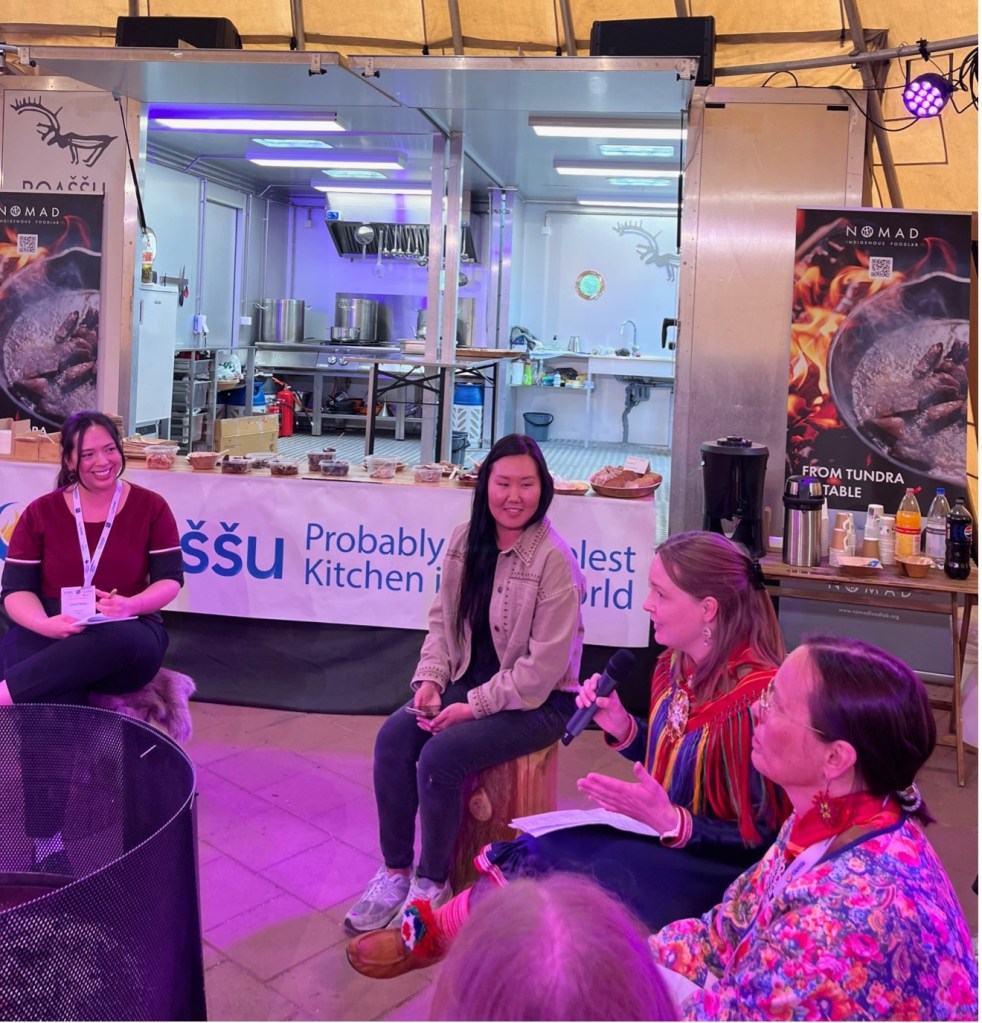
One unforgettable moment in this session was when Jaw commented that reindeer had such beautiful eye lashes, and as kids, they used to take the eye lashes[1] as part of the play to “dress up”. It caused laughter among the audience when she at the same time drew attention to the teens of today who buy eyelashes from beauty stores. Another topic mentioned in the session was about youth no longer eating Indigenous food. However, the NOMAD Indigenous FoodLab chef Anders Larsen had a key to change this by including Indigenous food in pizzas and tacos.
In the panel debate in session 4.1.11, where Brattland and Viikari took part, the importance of integrating traditional knowledge and practices into the educational system, were discussed. The previously mentioned Young Hunters program in Nunavut does just this, and it has shown positive results, not only in terms of increasing the consumption of traditional food but also in improving mental health and cultural pride among the youth. During the panel discussions, the need to decolonize the food system were brought up, and one argument was that policies need be modernized to support and promote traditional food systems. The panel emphasized the importance of observation, sustainable harvesting, and the inclusion of indigenous perspectives in governance systems to achieve this.
Seminar and Excursion to Duokta Reindeer Herding District
On June 4th, the Máhtut project partners, together with the Sámi parliament of Norway, the Nordland Research Institute and Sámiráđđi arranged a seminar and an excursion to Vatnvatnet (part of Duokta Reindeer Herding District) to get acquainted with the local area and Sámi reindeer husbandry in the Sállto region.
The morning seminar was hosted by the Nordland Research Institute. Camilla Risvoll, Áslat Holmberg and Karin Nutti Pilflykt (Sámiráđđi) Vivi Pedersen (Sámediggi) and Camilla Brattland presented. We were a diverse group of participants from Sápmi, Canada, Alaska, Aotearoa New Zealand and Holland who discussed challenges, approaches, and policies related to local, indigenous, and Sámi food systems. Topics included climate change, land use change, and predators impacting Sámi reindeer husbandry. Discussions also covered the role of Sámi in EU and International food policy and management, as well as the development of the Sámi Parliament’s Sámi food systems policy.
After the seminar, we took a bus to Vatnvatnet, where we were welcomed by Mats Jonas, Anfinn and Ing-Lill Pavall, representatives from VisitReindeer and Duokta Reindeer Herding District. We were served bidos (reindeer soup) and gáhkku (klappekake) for lunch, and after we sat together by the waterline, while Mats Pavall presented challenges and opportunities in relation to reindeer herding in the area. We ended the stay at Vatnvatnet with a walk to a nearby viewpoint where Pavall talked about harvesting wild plants.
There are similarities between the challenges presented by the Pavall family and the topics addressed in the various sessions on Indigenous food systems at the Arctic Congress. Indigenous food systems are complex and face numerous challenges, including climate change, loss of traditional knowledge, and limited access to resources. By recognizing and supporting indigenous rights and knowledge, we can help ensure sustainable and equitable food systems for all. A big thank you to the Norwegian Sami Parliament for supporting the seminar and excursion!
Key “take-home”-messages:
- Loss of traditional knowledge, such as about harvesting and preparing traditional food, is a challenge.
- Foraging is seen as an important part of being self-sufficient with food.
- It is important to find sustainable solutions and business models that can support local food systems and create economic opportunities.
- There is a need to modernize policies. Policies are holding people back.
- Sustainable management of natural resources is crucial to ensuring food security for future generations.
- Traditional knowledge about food gathering and hunting is invaluable and must be preserved and passed on to younger generations.
- Strengthening indigenous participation and leadership in decision-making processes related to food systems is essential.
- The connection between food security and traditional knowledge: Several sources emphasize the importance of traditional knowledge in ensuring food security, especially in remote areas.
- The role of youth in preserving traditional knowledge: It is a recurring theme that it is important to involve youth in learning about and passing on traditional knowledge related to food and foraging.
[1] This was from slaughtered, not living, animal.
 MÁHTUT
Leave a comment