
At the end of October, MÁHTUT Project Planner Eleonora Alariesto traveled to Reykjavik to participate in the screening of the documentary ‘Orsugiak – The White Gold of Greenland‘ and the following panel discussion at the Arctic Circle Assembly 2025 conference. During her trip, Eleonora also presented the MÁHTUT Project and her master’s thesis research, ‘Gullát Rástigáisá – Wind Industry as a Contaminant in Sacred Sámi Cultural Environments,‘ at the National Museum of Iceland.
The documentary Orsugiak – directed by Otto Rosing and Claus Pilehive – focuses on the colonial relationship between Denmark and Kalaallit Nunaat, as well as the history of cryolite extraction. Released in February 2025, the film follows the protagonist, Dr. Naja Dyrendom Graugaard, as she explores her family’s personal history while delving into the broader context of mineral extraction. The documentary examines power dynamics from a decolonial perspective, asking how Denmark has generated significant revenue and institutional wellbeing from extractivism on Inuit land, while leaving negative impacts on the local community. Beyond exposing the colonial dynamics and challenges of mining, Orsugiak serves as a powerful case study of colonial narratives and what unfolds when Indigenous voices are elevated on a national stage. After the documentary’s premiere in Denmark in February, Danish media outlets heavily criticized it for being biased and spreading misinformation, despite the extensive academic work supporting it in both archival and economic research. One week after the film was aired, it was retracted from the Danish Broadcasting Corporation (DR).
The panel following the screening included Danish-Kalaaleq Professor Naja Dyrendom Graugaard, UNESCO Gender Equality Studies Programme Specialist and Professor Giti Chandra, Chair of the Inuit Circumpolar Council and Professor Sara Olsvig, historian and Associate Professor Sumarliði Ísleifsson, and MÁHTUT Project Planner Eleonora Alariesto.
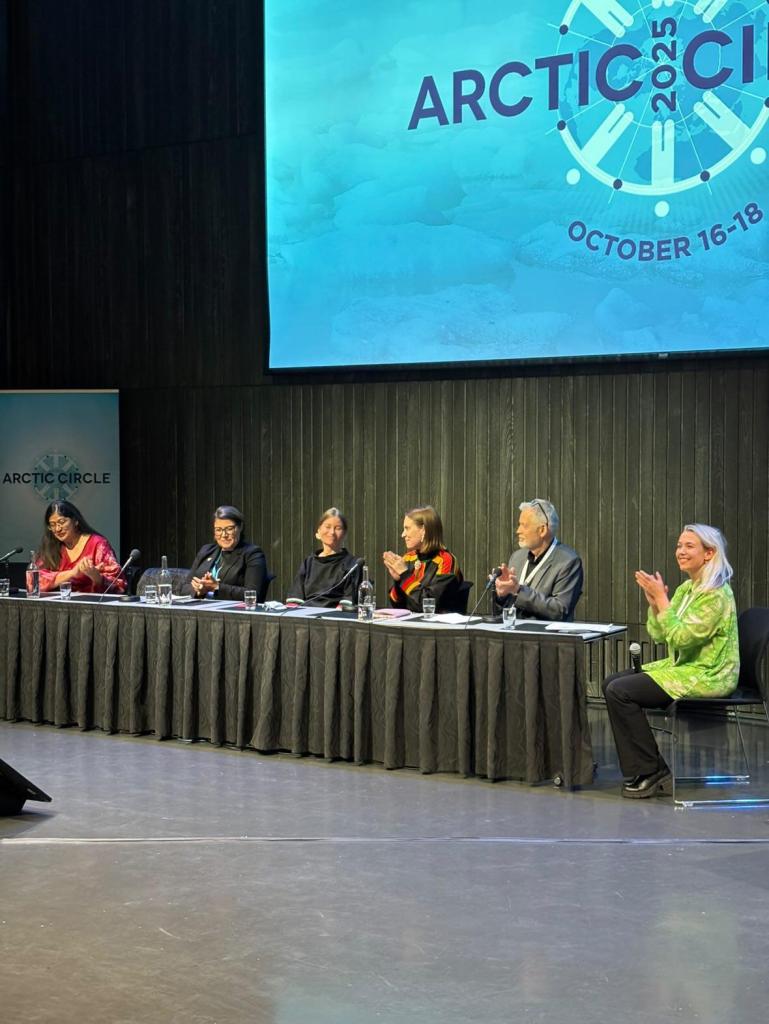
During the panel, the themes of the documentary were discussed – including Denmark’s colonial narrative as the “good colonizer,” the economic, sociocultural, and spiritual imbalances created by the extraction of vast amounts of rare earth and critical minerals, the link between historical colonial extractivism and contemporary energy transition discourse, and the importance of continuing to speak out about inequalities despite potential backlash.
Dr. Graugaard spoke openly about the racist and sexist backlash she faced after the documentary’s release, sparking discussion about the hierarchies between Western and Indigenous knowledge systems. When Western expertise is considered the societal norm and viewed as “objective,” Indigenous knowledge and research are often perceived as “biased” or “emotional.” The panelists also emphasized that educating about colonial histories should never rest solely on marginalized communities but must also be the responsibility of the majority population. Building alliances and solidarity against patriarchal and colonial power structures is key to decolonizing discourses that reveal how the wellbeing of some continues to rely on the marginalization of others. In the panel, Eleonora also drew parallels between mineral extraction and the silencing of Indigenous voices in the ongoing court cases between Sámi reindeer herders and the wind power industry. Both reflect colonial power dynamics that employ strategic ignorance as a tool to discredit Indigenous perspectives while privileging Western expertise through institutional structures.
Overall, the screening and panel discussion were a great success — the hall was filled with people eager to see the documentary and tune in to the conversation.
The following day in Reykjavik, Eleonora presented the MÁHTUT Project and her master’s thesis research at the museum. In her presentation, she built mental and historical bridges connecting Sámi pasts, presents, and futures, continuing the themes explored in Orsugiak.
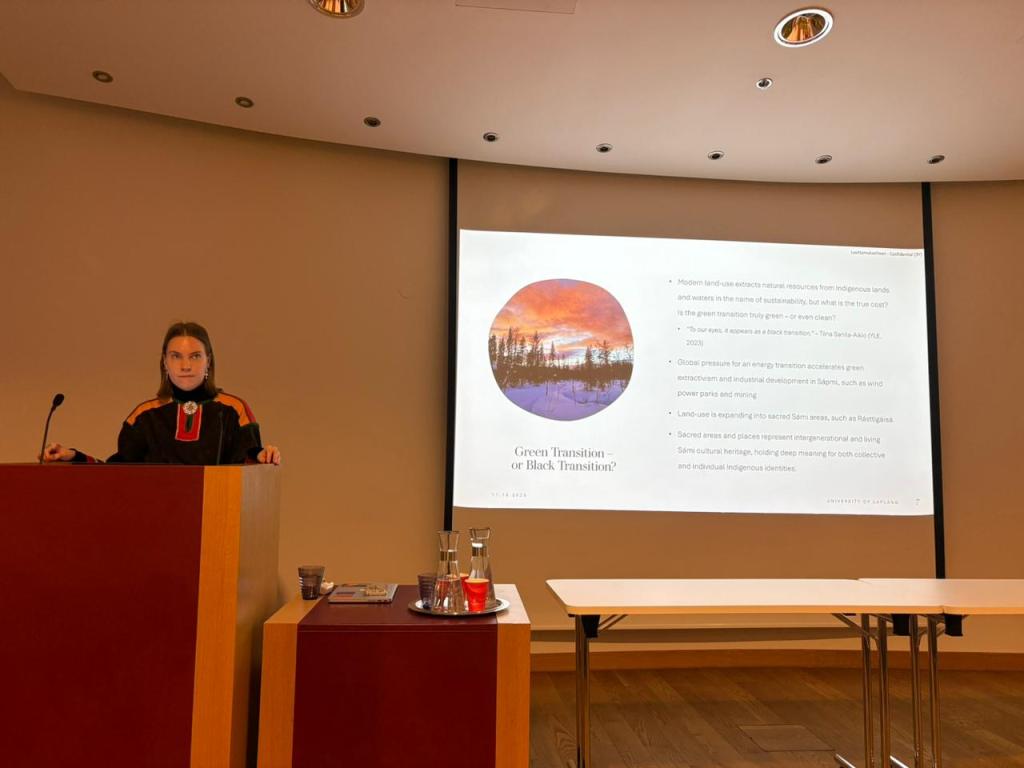
In Sámi understanding, the different layers of time overlap and intertwine in various ways and are not always perceived as separate from one another. This becomes evident, for example, in Sámi cultural environments where tangible and intangible dimensions communicate the ways of the ancestors, while simultaneously serving as meahcci – living landscapes of ongoing subsistence and cultural practices. Eleonora’s research also overlaps with the themes of the Orsugiak documentary in its exploration of European racial supremacy over Arctic Indigenous communities and how colonial hegemony over resources is manufactured through colonial power dynamics.
Olu giitu to Sólveig Sigurðardóttir and Giti Chandra from the RIKK Institute at the University of Iceland, and to Dr. Naja Dyrendom Graugaard for the invitation and for hosting such an exceptional panel following the groundbreaking documentary that continues to pave the way for Indigenous voices in the future.
Eleonora Alariesto
MÁHTUT Project Planner
 MÁHTUT
Leave a comment