

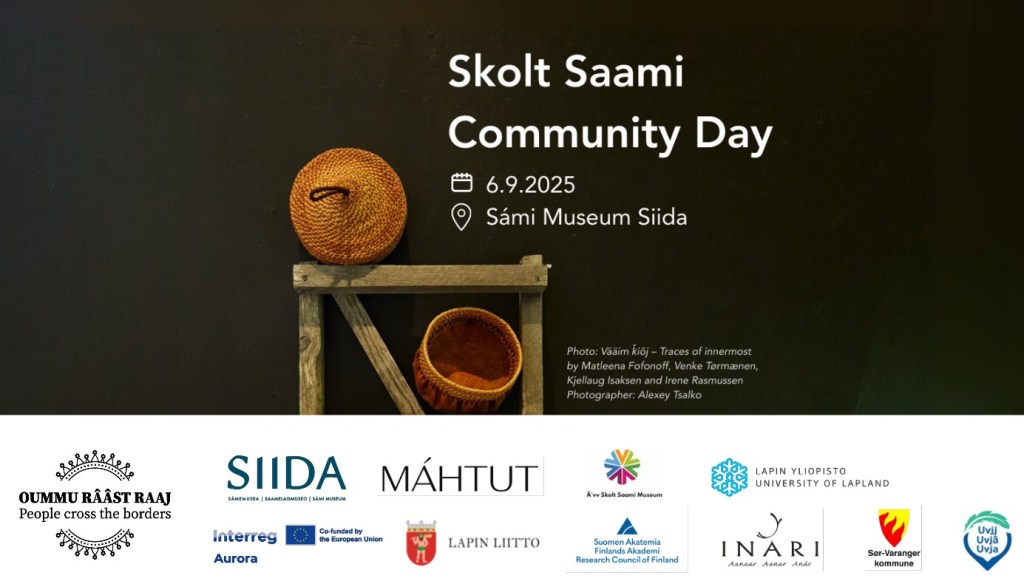
The MÁHTUT project, in collaboration with the Oummu raast raaj – people across the borders and SÁMIPOLITY projects, organized a Skolt Saami Community Day in September 2025 in Inari, at the Sámi Museum Siida. The Sámi Museum Siida and the Ä’vv Skolt Sami Museum were also involved in organizing the Community Day together with the projects. To ensure broad participation in the event, we arranged transportation for participants to Inari from Kirkenes and Sevettijärvi, as well as from Nellim and Ivalo. In the end, more than 70 people took part in the Community Day.
The purpose of the Skolt Saami Community Day was to support the revitalization of the Skolt Saami language and culture, and to bring together the Skolt Saami community from Norway and Finland to get to know their cultural heritage at the Sámi Museum Siida. We wanted to create a safe space specifically for participants of the Skolt Saami community day, a place where they could meet each other in peace and get familiar with the collections of the Sámi Museum Siida and its renewed main exhibition, Enâmeh láá mii párnááh – These lands are our children. In addition, the participants were able to become acquainted with the collection of Skolt Saami items held outside the main exhibition.
A shared desire to work closely with Sámi communities brought the organizing projects together. The central goal of all these projects is to support the preservation and transmission of traditional knowledge and skills, including through the repatriation and relearning of knowledge. Cooperation with memory organizations, such as museums, offered an excellent foundation for this work as community engagement, opportunities to connect with one’s own cultural heritage, and more broadly, the revitalization of knowledge to its communities have become key responsibilities of Indigenous museums in particular. In the 2000s, the repatriation of cultural heritage has become an essential part of cultural heritage work, both nationally and internationally, and is viewed as an important element of cultural heritage protection.
Distances in the north are famously long, and many of the participants of the Community Day had been awake for quite some time by the time the transports arrived in Inari. The Community Day in Inari was planned to begin with a shared lunch, which not only helped everyone get through the day, but also brought together participants arriving from different places before the rest of the program began. After lunch, the program continued in the Sámi Museum Siida’s auditorium, where the organizing projects were briefly presented. Following the presentations, experts from the Sámi Museum Siida spoke about the museum’s collection of Skolt Sámi items and, more broadly, about practices related to the collections. The Sääʹpääʹljes project, which investigates the current state of the Skolt Sámi language in Finland, took part in the Community Day and was also presented in the auditorium. As the event was expected to evoke a wide range of emotions and thoughts, we invited representatives from Uvja, the Sámi Psychosocial Support Unit, to ensure that the environment would feel safe for all participants. After the presentations, the short film Mon leäm säʹmmlaž was screened, produced by the OUMMU project.
The Sámi Museum Siida holds a comprehensive collection of Skolt Sámi items that were recently returned to Sápmi from the National Museum of Finland. Before the event, we invited participants to vote on which items from the Siida’s collection they wished to see and encounter during the Community Day. More than 300 items were selected for display, including clothing, hats, bags, and storage-related items. For many of these items, this was their first encounter with the Skolt Sámi community since they had originally been taken from Sápmi to the collections of the National Museum of Finland.
After the event, we collected feedback on its successes and areas for improvement through an online form. According to the responses, the Community Day was deeply meaningful and moving for many, as several of the items on display had been made by people they knew or by their relatives. In addition, some participants from the Norwegian side encountered lost cultural heritage and handicraft traditions for the first time. It is fair to say that the Community Day became part of an ongoing process of restoring knowledge at both local and personal levels. The collection sparked memories and connections to past generations and the traces of their hands, while also offering an opportunity to build a future and strengthen identity for individuals and communities across national borders.
The Community Day laid important groundwork for future collaboration between the projects, where traditional knowledge will be revived and traditional circular practices will be explored through making duodji, drawing on museum collections and hands‑on making. We will share more about this in future posts during the spring.
Furthermore, during the ongoing spring we published a collaborative report about the Skolt Saami Community day with Oummu project, that can be read here: Report of the Skolt Saami Community Day
You can read more about the Community Day from here:
Yle Sápmi, Sunna Guttorm, 9.9.2025 Yhteisöpäivä kokosi kymmeniä kolttasaamelaisia yli rajan: ”Historiallinen ja tärkeä päivä”, iloitsee osallistuja | Saame | Yle
ArcticToday, Deniz Zagore, 15.9.2025: The battle for the Skolt Sami language – ArcticToday
 MÁHTUT
Leave a comment